Travel Notes - Datong
2026-04-16
I spent the weekend in Datong and came away with many reflections. I visited Datong Ancient City, the Yungang Grottoes, Huayan Temple, Fahua Temple, the Yingxian Wooden Pagoda, Yingxian Jingtu Temple, Guandi Temple, and Pure Yang Palace. Some of these are truly ancient structures, while others were built later. Throughout the trip, my emotions were complex: I felt sincere admiration for the master craftsmen and scholars of both past and present, deep anger toward the destruction of cultural relics, and also found myself reflecting on certain actions of those in power, along with some personal realizations.
I want to first record the moments that moved me. For example, seeing the “Bodhisattva with folded hands and a smiling expression” at Huayan Temple; seeing in Cave 16 of the Yungang Grottoes a posted image of a stolen Buddha statue now housed in the Metropolitan Museum of Art in New York, and then finding on my phone the original photo I had taken; seeing the Buddha statues in grottoes and ancient temples gazing compassionately upon all living beings; thinking about the scholars of the Society for the Study of Chinese Architecture who risked their lives climbing to the top of the Yingxian Wooden Pagoda—nearly the height of a modern 22-story building—to conduct measurements… I exist in the present, yet resonate and empathize with people from different times and spaces. For me, this seems to be one of the meanings of travel.
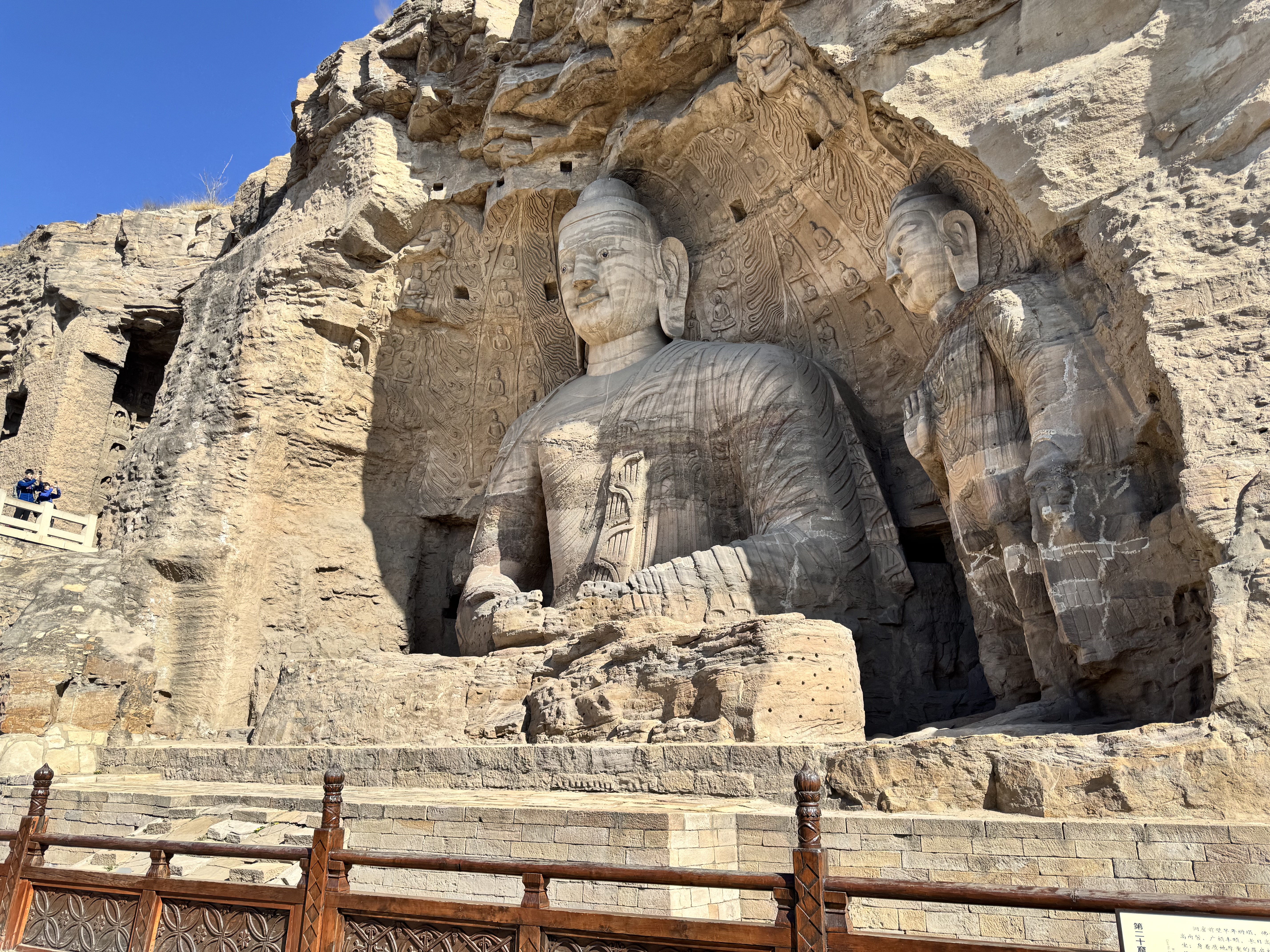 Buddha Statue, Yungang Grottoes, Datong
Alongside these moving moments was a deep sense of pain and regret upon seeing cultural relics damaged by human hands. Starting with the Yungang Grottoes: they have existed for over 1,500 years since their carving. Because they are made of stone, most are very well preserved. While I was awed during the visit, I also noticed many carvings and murals marked with “I was here” graffiti—wherever people could reach, traces of the past remained. I even saw “August 1976” carved into the arm of a tall Buddha. On the day I visited, I also heard other tourists expressing disgust toward those who carved their names. Today, a layer of glass has been installed to protect the relics, but the damage from the past will remain forever. Although I am just an ordinary visitor, seeing ignorant and arrogant individuals recklessly destroying cultural relics—and the absence of management to restrain such behavior—filled me with deep sorrow.
Beyond the grottoes, the Yingxian Wooden Pagoda has also suffered from human-caused damage. In the 1920s and 1930s, local elites followed the advice of a feng shui master and removed structural outer walls, replacing them with doors and windows, which caused the pagoda to begin tilting. During the warlord conflicts of the Republic of China period and the Chinese Civil War, countless shells struck the interior of the pagoda. Although its structure was not fundamentally damaged, these marks remain like permanent internal wounds. A wooden pagoda that had stood for nearly a thousand years endured such destruction in just the past century.
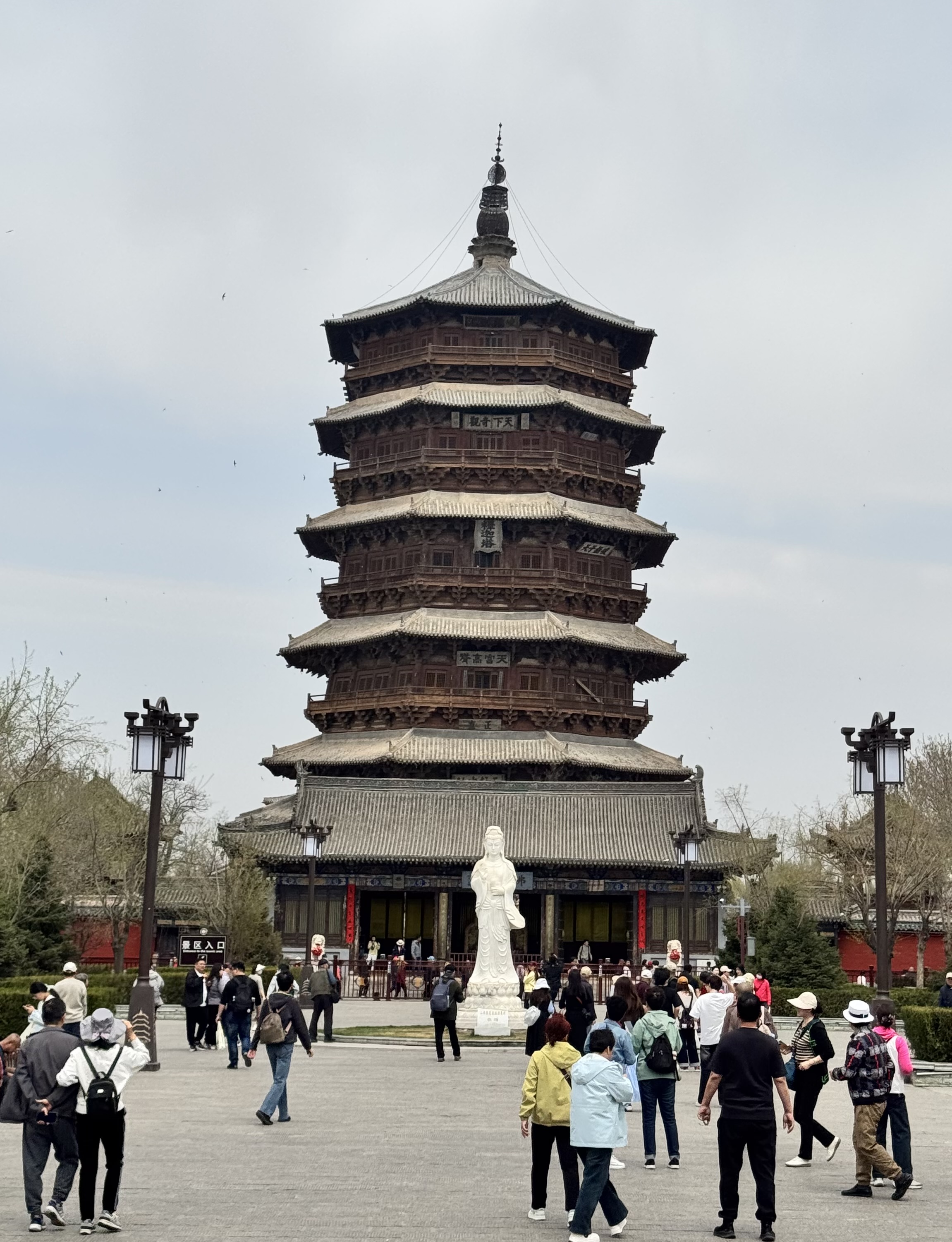 Yingxian Wooden Pagoda, Datong
At Jingtu Temple, not far from the pagoda, there is a pair of disheveled stone lions once praised by Liang Sicheng as one of Yingxian’s three treasures. When I visited, I saw that the lions’ legs were gone, with a nearby sign explaining that they had been damaged later.
This kind of destruction is not limited to what I saw on this trip. In my hometown, Hejin in Shanxi Province, there was once a well-preserved ancient county city, but it was demolished after the founding of the People’s Republic and has completely disappeared. In my village, there was once an ancient temple, which villagers demolished to build a primary school or for other uses. The demolition and reconstruction of Tiananmen in Beijing, the tearing down of the Beijing city walls, and countless other acts of cultural destruction have been forgotten by who knows how many people… Thinking about all this, I feel deep sorrow. We are destroying our own culture without even realizing it.
Another realization I had is that some things may seem insignificant to certain people, yet to others they are deeply cherished. Even for oneself, perspectives and emotions toward things can change with age. My conclusion is that we should maintain a sense of deference for what others care about and for what we ourselves do not yet understand.
For example, before I watched the TV adaptation of Romance of the Three Kingdoms, I felt nothing toward Guandi Temples. But after watching it, when I stepped into the Guandi Temple in Datong, I could understand every story depicted in the murals, and I gained a deeper understanding of Guan Yu. The excitement I felt was something my former self could never have imagined.
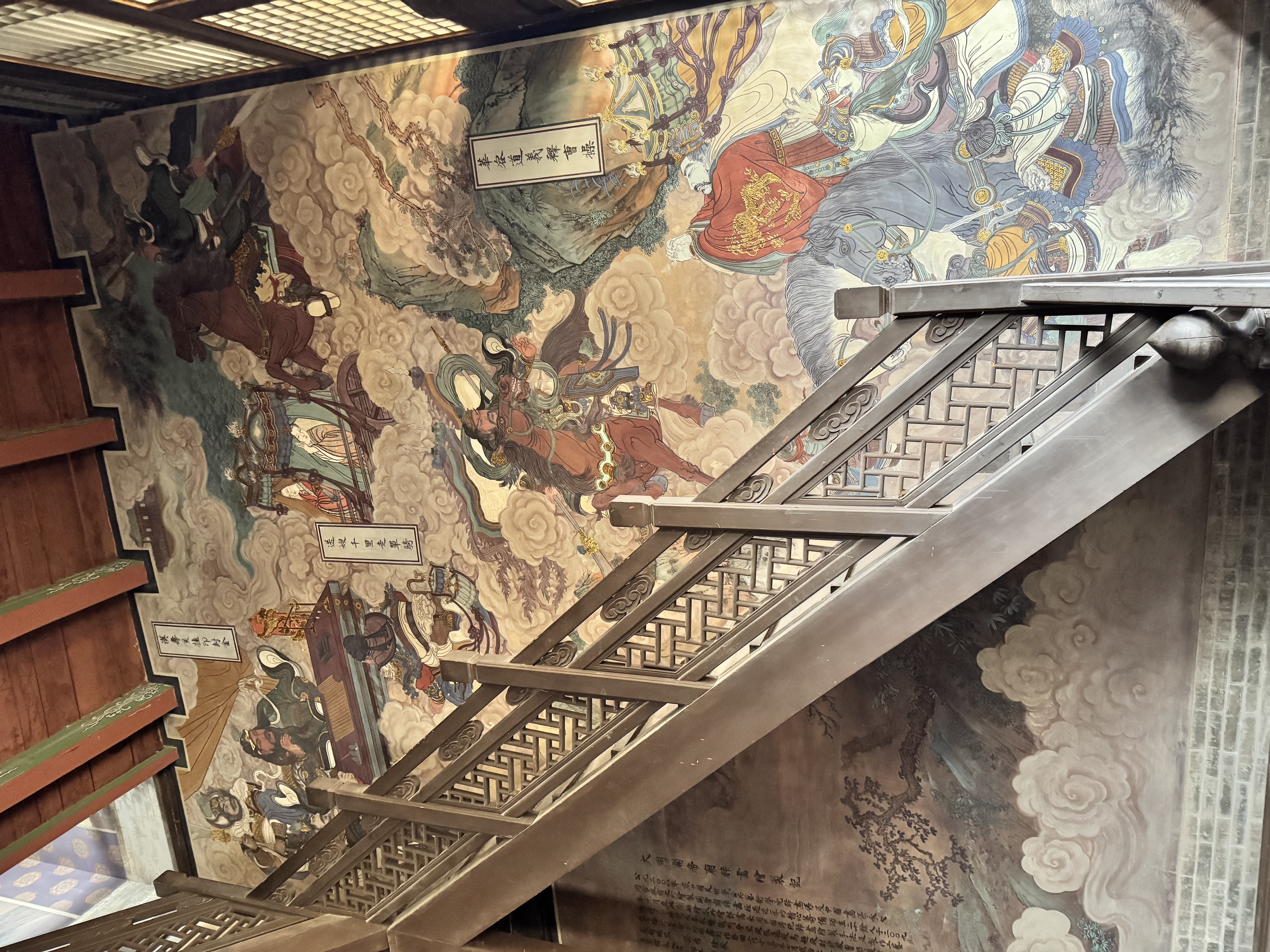 Mural, Guandi Temple, Datong
Imagine this: I once owned a beautifully illustrated album of Romance of the Three Kingdoms characters, but out of ignorance I failed to protect it and it was damaged. Later, when I became fascinated with the Three Kingdoms, I realized I could never recover that album. How great the sense of loss and regret would be.
In addition to insights gained from ancient architecture, I also had some reflections while visiting Datong Ancient City. Back in college, one of my good friends was from Datong, and she often praised the city’s mayor, Geng Yanbo. The taxi drivers I rode with also spoke highly of him. It seems he did accomplish many things beneficial to people’s livelihoods. While visiting Huayan Temple, I noticed that the couplets at the temple gate and the Puguangming Hall were written by Mayor Geng; the same was true for the gate of Fahua Temple, and also for the Lingyan Temple gate and the Mahavira Hall at the Yungang Grottoes. There is even a stele at Huayan Temple: on the front is an inscription about the temple’s restoration, and on the back is a “warning stele” written by Mayor Geng, where he lists three mistakes he made, including starting construction without approval from the National Cultural Heritage Administration. At the Yungang Grottoes, I also saw an inscription written by the then director of the Yungang Research Institute about road construction, mentioning that it was suspected of violating regulations and had faced accountability.
This led me to some questions. Were these bold and decisive actions driven by public interest or private motives? Are these steles a form of self-promotion? Isn’t carrying out such work simply part of one’s duty? Should a person in power erect monuments to narrate their own actions? Do so many famous temples really need so many couplets written by the mayor? I must admit that Mayor Geng’s couplets do have a certain level of quality—but is this appropriate? I remain doubtful. At the very least, the two steles I saw in Datong made me uncomfortable with this tendency of self-praise or self-narration among those in power. I do not think this is a healthy practice.
Another realization is that I became more aware of what I truly value. On Saturday at dusk, I sat alone beside the white pagoda at Fahua Temple. There was no one around. As the sky darkened, the wind chimes beside the pagoda rang gently in the breeze, producing a pleasant sound. Birds circled around the pagoda. Watching all of this, I felt calm and at ease. Then I suddenly wanted to share this beautiful feeling with a dear friend who is no longer alive. I know that those who are alive may have such moments at some point, but she no longer can. I miss her deeply, yet there is nothing I can do.
I thought of Alyosha and the schoolboys in The Brothers Karamazov burying Ilyusha, and how Alyosha told them to remember him, to be honest and kind, and never to forget one another. I began to choke up. “Unless a grain of wheat falls into the earth and dies, it remains alone; but if it dies, it bears much fruit.” I believe my friend has borne much fruit as well. And perhaps part of my will is one of those grains she has left behind. For me, I hope I can bring good things to others: encouragement and praise, sincere blessings and love, kindness in daily life, products created through serious work that truly improve user experience, works that inspire people… perhaps these are what this grain of wheat in me hopes to leave behind.
There are still many parts of this journey that I haven’t put into words. Briefly: a hotel receptionist upgraded my room for free, saving me over a hundred yuan—very grateful to her. I ate naked oat noodles, Hunyuan cold noodles, knife-cut noodles, sweet and sour pork, and lamb shumai. I mostly took taxis; a round trip from Datong to the Yingxian Wooden Pagoda cost 200 yuan, and the driver was quite kind. Also, it’s better to head out early—otherwise, it’s all tour groups.
Heading home. Beginning a new life in Beijing.